
The Future of Business: Ten editions of Changemaking in Action
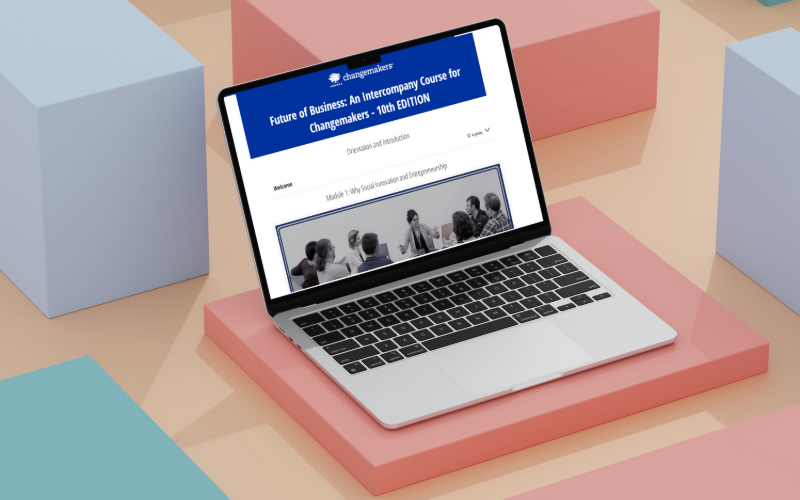
The Future of Business course reflects Ashoka’s mission of a world where everyone is a changemaker. This learning journey is an effort to equip professionals with the knowledge, tools, frameworks, and mindset to transform business as usual into business as a force for good.
Written by Isabela Carvalho, Program and Knowledge Management for Social Change at Ashoka
When I launched the first edition of the course back in 2020, my partner in co-creation Yeleka Barrett and I wanted to offer not only an online course, but a journey that allowed professionals in the private sector to see that changemaking can happen from any role, in any type of institution. At a time when a global pandemic was forcing programs and all kinds of initiatives to move online, we built on years of experience in implementing high-quality engagement opportunities for people living in all corners of the world, using what technology had to offer. We made a big bet, and the results came in the form of many stories of impact and strong data.
We recently celebrated its 10th edition, and more than a symbolic milestone, it represents a cumulative effort to build an intercompany learning space where systemic change becomes tangible, where learners often share that the course helped them see themselves as changemakers, and where the idea of collaboration instead of competition is not only a dream.
Across the ten editions, over 800 participants from more than 50 companies and countries have joined the course. In the most recent cohort alone, more than 150 professionals enrolled, representing over 40 companies and 35 countries. Among them were business executives, mid-level managers, and nonprofit professionals working with corporations, from global multinational businesses like IKEA and Kersia to medium-sized enterprises, foundations, and innovators in Africa, Latin America, and Europe.
What they all shared was a common question: how can I use my role to drive positive change?
The Future of Business helps them to find this answer by using Ashoka’s 45 years of experience working with and learning from leading social entrepreneurs and intrapreneurs. It explores the frameworks that matter most – the business case for social intrapreneurship, levels of impact and systems thinking, co-creation, collaboration across sectors, stakeholder mapping – and connects them with practical application. The course’s impact speaks for itself: our completion rate is over 65%, well above industry benchmarks for online courses; more than 90% of our participants report that the course increased their desire to collaborate with people across sectors to solve social problems; and over 80% said the experience strengthened their ability to innovate within a company.
But beyond numbers, what makes the Future of Business transformative is the clarity it gives people about their own changemaker identity. Participants reported a sharp increase in their skills and confidence. More than 80% said the course empowered them and gave them the tools to promote changemaking in their environments and communities. Many described deep personal transformations, realizing for the first time that they do not need to leave their companies to make an impact; they can be social intrapreneurs, shifting systems from within.
One participant shared: “All my life, I thought I had to leave corporate to make a difference. Now I understand I can change systems from within.”
The importance of collaboration across sectors and industries is one of the most common insights from learners. This is especially important because systemic, lasting change does not happen in isolation. It requires both external pressure and internal evolution. For example, social entrepreneurs pushing boundaries and social intrapreneurs changing the rules from the inside. As one graduate noted:
“The power is in co-creation (…) Building networks of co-creators makes your mission more achievable – and more enjoyable.”
The course is also shaping real-world action. Post-course evaluations revealed that participants were not only inspired; they became active. Some launched intrapreneurial initiatives inside their companies, some are now training peers using the course materials and frameworks, and others started impact reports using new systems-change lenses. Several even partnered with local organizations to co-create community programs.
As we prepare for the next editions, the goal is not only to increase the numbers but to deepen the impact, build stronger ecosystems, and allow more people to unlock their changemaking power. My team and I believe that systematizing and sharing knowledge is key to transforming the way people understand social impact and helping them see how they can contribute, regardless of age, class, geography, or professional choices.
If you are in the private sector and believe your company can use its resources to create positive change in the world while also building a more sustainable way to do business, we are here to work with you!
Reach out to us, and let us talk about joining the next edition.